
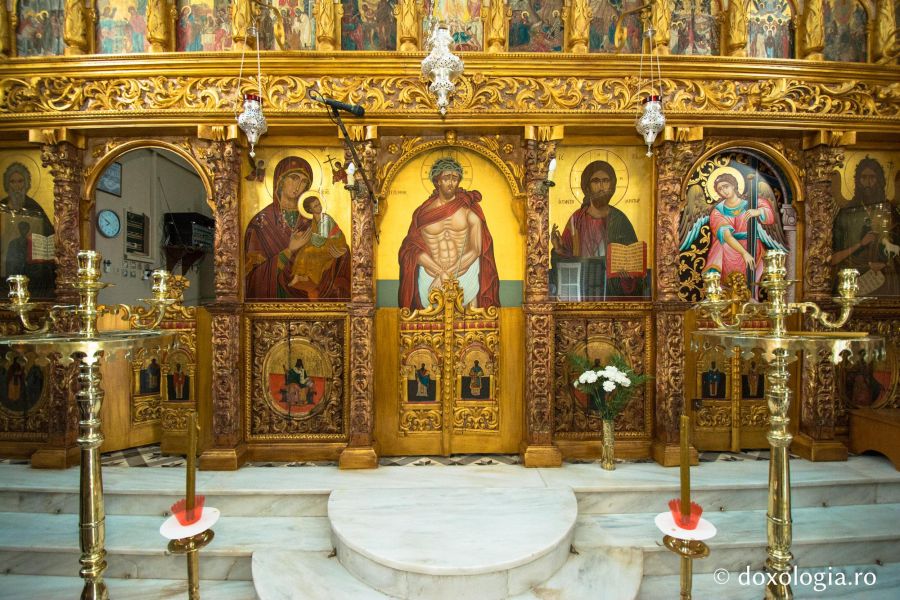
To understand this landscape, you have to imagine the sea not as a border, but as a road. For centuries, the Ionian Islands were crossed by ships, merchants, artists and travellers. Corfu, Zakynthos, Cephalonia and the other islands had different relationships with Venice at different times, before coming under other forms of rule after 1797. Venice brought more than fortresses and trade: along the routes of the Mediterranean came artistic, architectural and musical models that encountered a deeply Greek and Orthodox culture.
It is above all in the icons that this encounter becomes visible. The Byzantine tradition remained the starting point, but the artists of the Ionian Islands increasingly looked towards Venetian and Italian painting. Between the seventeenth and nineteenth centuries, what is commonly known as the Heptanese School developed, one of the most original experiences in Greek painting. The images continued to depict Christ, the Virgin and the saints, but the way they were portrayed slowly changed: perspective became more pronounced, bodies acquired volume, light began to shape faces and spaces grew deeper. Yet the icon remained an icon, and the East was not erased by the West. The two traditions met, influenced one another and were reworked by local artists. It is precisely this continuity, together with transformation, that makes the Ionian churches so fascinating. On one side there is gold, symbolising a dimension beyond the earthly world. On the other, a more tangible light, capable of creating shadows, depth and movement.
Then comes the singing, and the story changes again. Byzantine chant, traditionally based on a single melodic line, remains an essential part of Orthodox liturgy. In the Ionian Islands, however, alongside this tradition, multi-voice forms of singing also developed, particularly in certain local contexts and in repertoires associated with Heptanese culture. This is one of the features that can most surprise visitors arriving in the Ionian Islands after travelling through other parts of Greece. The famous kantádes and other multipart repertoires bear witness to a musical culture in which different influences were absorbed and transformed into something deeply local.
But the history of liturgy in the Ionian Islands is not confined to churches; you have to step outside, follow the sound of the bells and watch people gathering in the streets. During major celebrations, faith can move through the towns in procession. Icons and relics leave their sacred buildings, while communities take part in rituals that are both religious and expressions of identity. In Cephalonia, this memory has the face of Saint Gerasimos. His relics are kept in the church dedicated to him, and the processions held in his honour are among the most deeply felt expressions of the island's religious tradition.
Earthquakes, finally, have radically altered the face of the Ionian Islands, destroying or damaging numerous churches. As a result, the past can appear in unexpected ways: entering a building reconstructed in the twentieth century, you may find icons that have survived centuries of history. Some works have been lost, while others have been restored, moved or preserved in museums and ecclesiastical collections. It is as though time does not move in a single direction, but overlaps: every reconstruction adds a layer, every earthquake removes another. And what remains becomes all the more precious.
Stepping back outside the church, the sea seems different. After seeing the icons, hearing the chants and following with your eyes the traces of a history stretching back centuries, the Ionian Sea appears for what it has been for generations: not a frontier, but a passage. And this is precisely the fascination of our islands: they did not choose between two worlds; they made them coexist. Inside a church, in the gold of an icon, in the smoke of incense, in a single voice rising towards the ceiling or in a choir suddenly filling the space, you can still hear the whole Mediterranean. And outside, always, the sea.
Sources and further reading
- National Gallery of Greece — The School of the Ionian Islands
Catalogue dedicated to Ionian painting and the evolution of Greek art under Western influence. - "National Gallery of Greece" (https://reference-url-citation.invalid/0)
- Aphrodite Kouria — “Secular painting in the Ionian islands and Italian art: Aspects of a multi-faceted relationship”, The Historical Review / La Revue Historique, 2016. A study of the relationship between Italian art and the visual culture of the Ionian Islands.
- "The Historical Review / La Revue Historique" (https://reference-url-citation.invalid/1)
- Giuseppe Sanfratello — Le kandàdhes dell'Eptaneso: un repertorio di canto 'artistico' e 'popolare'. Research on the multipart vocal traditions of the Ionian Islands and their relationship with local musical practices.
- "Edizioni Ca' Foscari" (https://reference-url-citation.invalid/2)
- University of Catania – IRIS, Ethnomusicological research on the vocal traditions of Corfu, Cephalonia and Zakynthos.
- "IRIS – University of Catania" (https://reference-url-citation.invalid/3)
- Greek Music Information Center, Materials on the Heptanese School of music and the history of modern music in the Ionian Islands. "Greek Music Information Center" (https://reference-url-citation.invalid/4)
- Corfu Tourism / Municipality of Corfu, Materials on the religious tradition of Corfu and the cult of Saint Spyridon. "Visit Corfu" (https://reference-url-citation.invalid/5)