
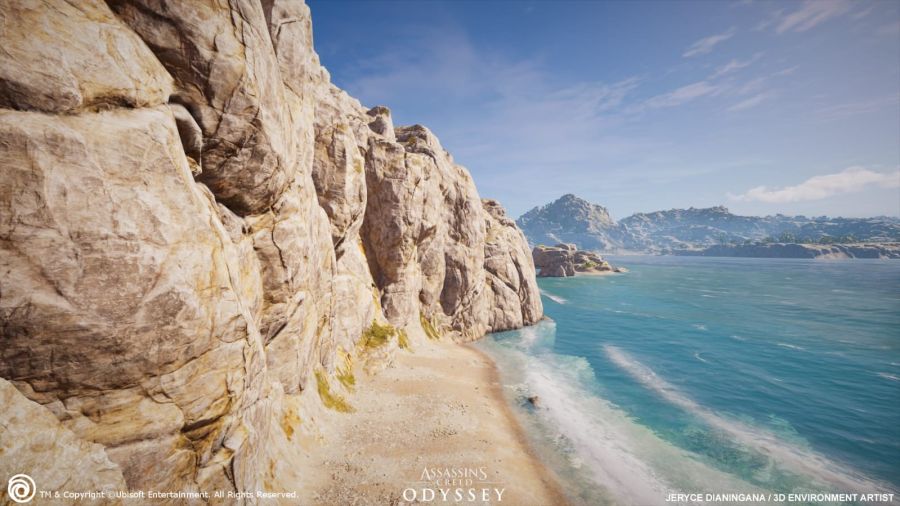
In the game, the island of Kefalonia has been recreated as a sort of "digital twin": not a perfect copy, but a condensed version, designed to be freely explored among cliffs, mountains, and sea, while maintaining a surprisingly realistic look. According to Ancient World Magazine, the developers' goal wasn't absolute precision, but rather to create a believable and, above all, fun-to-explore ancient Mediterranean, turning Kefalonia into the starting point of the entire adventure and a kind of grand "playable introduction" to the world of Alexios or Kassandra.
And this is where it gets interesting: those familiar with the real island often feel like they already recognize something. The rugged coastlines and steep cliffs immediately recall the authentic landscape, the Sami area is easily identifiable as a natural center both in reality and in the game, and iconic locations like Melissani Cave become evocative and explorable settings, with that almost unreal blue light that closely recalls the atmosphere of the real cave, one of the island's most beloved attractions. Even the island's beaches find their "digital double," with their instantly recognizable white cliffs and turquoise sea, while Ithaca is appropriately positioned nearby, allowing you to navigate between the islands just as you would in real life, reinforcing the sense of a coherent and living world.
But Kefalonia in the game isn't just a landscape: it's also intertwined with myth and history. The connection to the figure of Odysseus in Homer's Odyssey is always in the background, along with archaeological references inspired by reality, such as tombs, temples, and ruins that recall the island's actual findings, albeit reworked for narrative purposes. One of the most fascinating aspects is precisely the mix of realism and "poetic license": the game world is brighter, more saturated, almost always bathed in sunlight, with often idealized ruins and magnified monuments (for example, the statue of Zeus wielding a thunderbolt, which in the game is located on a cliff on the eastern side of the island), and a reduced scale to make exploration compelling and fluid. In short, the game isn't a mere replica, but a version designed to make you want to get lost.
The result is curious: many travelers today arrive in Kefalonia with a feeling of familiarity, as if they've seen certain views before. And indeed, in a certain sense, that's exactly how it is. Because the line between video games and reality is blurred here. And Kefalonia becomes one of those special destinations where the journey doesn't begin upon arrival... but long before, in front of a screen.