
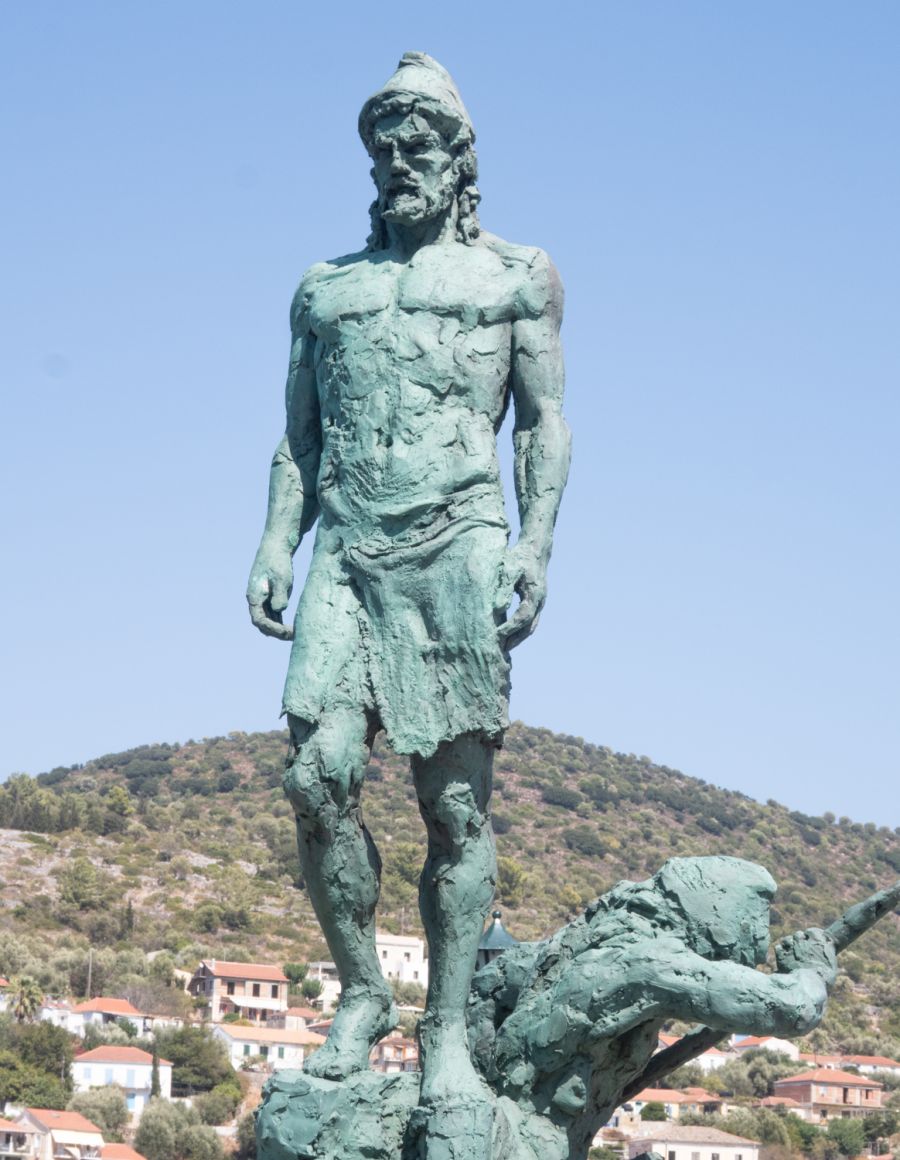
The geography described in the Odyssey is extraordinarily precise. Homer speaks of an island "low, the westernmost, facing the sunset," surrounded by other lands. References to mountains, natural harbors, sheltered bays, and inland routes seem to trace a real map rather than a mythical landscape. While for centuries the identification of these places with modern-day Ithaca seemed natural and indisputable, some recent studies highlight inconsistencies between the Homeric text and the island's current morphology.
In 2005, the book Odysseus Unbound: The Search for Homer's Ithaca by Robert Bittlestone, James Diggle, and John Underhill reignited the debate with a bold theory: Homer's true Ithaca may have been located in western Kefalonia, on the Paliki peninsula. According to this hypothesis, Paliki was not always a peninsula. Geological studies conducted in the Thinia Valley—the narrow strip of land that today connects the peninsula to the rest of Kefalonia—have identified traces of ancient marine sediments and submerged beaches. The hypothesis is intriguing: a gigantic landslide would have gradually filled an ancient sea channel, transforming what was once a separate island into a peninsula. If this process had occurred around 3,200 years ago, Paliki would still have been an island around 1200 BC, in the midst of the Bronze Age, a period traditionally associated with the Trojan War and the myth of Odysseus. In this scenario, Homer's description of an island facing the sunset and distinct from the others would find a plausible explanation.
Other research indicates that the heart of Mycenaean Ithaca may lie in another area of Kefalonia, in its southeastern part, between the coastal villages of Skala and Poros and the fertile plain that extends to Tzannata. Here, archaeologists have discovered monumental Mycenaean tombs, remains of buildings, and traces of a major Bronze Age settlement. Some scholars believe that this very area may have housed the political center of Odysseus's kingdom, with the royal palace, elite residences, and a necropolis connected by ancient ceremonial roads. The surrounding landscape indeed seems surprisingly close to the descriptions in the Odyssey. The southern coast of Kefalonia is the first point on the island reachable by sailing from the south. The spectacular Poros Gorge, crossed by a stream flowing from the mountains to the sea, also recalls the port of Rheithron mentioned in the poem, a landing place where the sea penetrated deeply into the hinterland following the course of a river. Even today, this landscape is striking for its power: a narrow, rocky valley that suddenly opens onto the blue Ionian Sea. Dominating the island's horizon is the massif of Mount Ainos, the highest mountain in the Ionian Islands, covered in dense fir forests. Some scholars have speculated that it may be related to the Neriton mentioned by Homer, the forested mountain that marked Odysseus's homeland from afar and which sailors could recognize from afar. Seen from the open sea, its imposing silhouette makes it easy to understand why such a mountain could become the symbol of an island in the memory of ancient Mediterranean sailors. If the Mycenaean center of this area truly controlled the Ionian Sea routes, Kefalonia may have been a strategic hub between the islands and mainland Greece, connected to territories such as Lefkada, Zakynthos, and the western coast of the Peloponnese. In this scenario, Odysseus' Ithaca would not have been a small, isolated island, but a key hub in the Bronze Age trade and maritime system.
For those traveling today, the definitive answer is perhaps less important than the allure of the quest. Walking through the olive-covered hills, gazing out to sea from the Poros Gorge, or following the roads that crisscross inland villages means moving through a land where myth and geography continue to dialogue after three thousand years. Every natural harbor could be where Odysseus secretly landed, and every hill could hold the echo of his return. And it is precisely this subtle line between history and legend that makes the Ionian Islands one of the most fascinating destinations in the Mediterranean.
Sources:
1. https://www.smithsonianmag.com/history/odysseys-end-the-search-for-ancient-ithaca-112739669
2. https://www.hellenicaworld.com/Greece/Geo/en/Ithaca.html
3. https://en.wikipedia.org/wiki/Odysseus_Unbound
5. https://homericithaca.blogspot.com/2025/11/the-center-of-homeric-mycenaean-ithaca.html
6. https://it.wikipedia.org/wiki/Itaca
7. http://homericithaca.blogspot.com/2025/11/the-center-of-homeric-mycenaean-ithaca.html